ChatGPT Dots Are Starting to Just Do Things

Table of Contents
I’m finding ChatGPT Dots more and more helpful. The little things are starting to add up, and this morning brought a good example of what I mean.
Dots are OpenAI’s always-on assistants that can take on ongoing work and keep making progress between conversations.
Kermit (what I have named my Dot, because of the green frog face) sent me a heads-up about a schedule conflict with my colleague’s lightning talk at AutoCon and my travel plans. A small thing, but exactly the kind of help I want from an assistant.
The best part about it was it was completely unexpected & unplanned. It just showed up without a prompt, and it is what excites me most about where we are going.
This Morning’s Heads-Up #
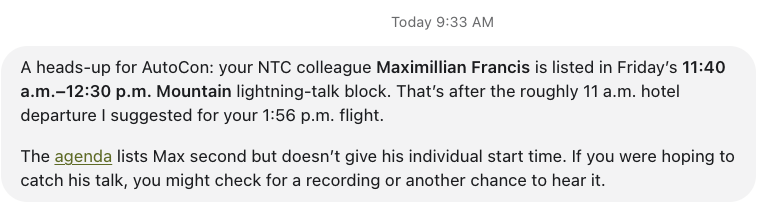
My colleague Max was listed in Friday’s lightning-talk block. Kermit connected that with the hotel departure time it had already suggested for my flight. The talk block started after I would be leaving.
It also called out a detail that matters: the agenda listed Max second, but didn’t give his individual start time. There was enough information to flag the conflict, with a suggestion to look for a recording or another chance to hear the talk.
If you’re at AutoCon 6 in Tucson, or catching the recordings afterward, tune in to Max’s lightning talk, The Peanut Butter & Jelly Method: Transforming Manual Tasks into Automated Workflows. He’s the second speaker in Friday’s 11:40 a.m.–12:30 p.m. lightning-talk block. Since Kermit tells me I’ll be headed to the airport by then, I’m counting on you to catch it for me.
The day before, Jeff Kala from Network to Code joins Joey Coakley from Microsoft for Compliance as an Enabling Constraint: Federating Nautobot Across a Segmented Network. That one is Thursday at 11:05 a.m. on Track A.
That’s useful. The conference agenda and my travel plans were pieces of information that needed to be considered together. Having that connection brought to my attention is one less thing for me to keep track of.
The Feature I Want Most: Teams #
The feature I most want next is teams. Grok’s Team Bots, which let people work with a shared bot, have me thinking about a team of assistants of my own. I’d like to have several Dots with different responsibilities that can share the relevant context and work together. I want to see the conversation going between the bots, with a similar back-and-forth to what you see when people collaborate on creative work.
That’s the direction I’d like to see Dots go, and it’s part of what keeps me experimenting with OpenClaw. I will likely start with some new OpenClaw environments, as every time I get the OpenClaw agent going, there is a bit of old cruft from experiments before. It reminds me of the Windows 98 days, when the machine had become bloated and the next best thing to do was rebuild and start fresh again.
More of This #
I’m still very excited about where things are going. Peter Steinberger has written about joining OpenAI to bring agents to everyone, and I’m excited to see that OpenClaw mindset reaching more people. I know there are others out there as well, including Meta’s Muse and Google. This is a great time to be exploring and learning what the capabilities are.
The capabilities being delivered by the AI labs are getting better and better each day. There are things that I desire from each of the systems, such as the teams and communications with Grok. In my use, Anthropic’s Claude models feel like the smartest, but the tools and interface around them are all business. OpenAI seems to be doing well on most, including providing the Decisions API for applications to classify inputs, choose between options, and score against a rubric, alongside Dots in ChatGPT.
I wouldn’t count Google out, either. Google designs its own Tensor Processing Units (TPUs), custom chips used to train and serve models such as Gemini. In its Trillium launch, Google reported up to 2.5 times better training performance per dollar and up to 1.4 times better inference performance per dollar over its previous-generation TPUs. Having that control over the hardware and software could give Google a cost advantage as AI usage grows. That’s part of why I think they could do very well in AI as a business.
Whatever platform gets there first, I want more of these small, useful moments—and a team of assistants that can connect the dots together.
-Josh